Summarize a PDF with Private AI Carefully
Generate a concise working summary from extractable PDF text using the configured private Ollama model, with explicit limits on grounding and review.
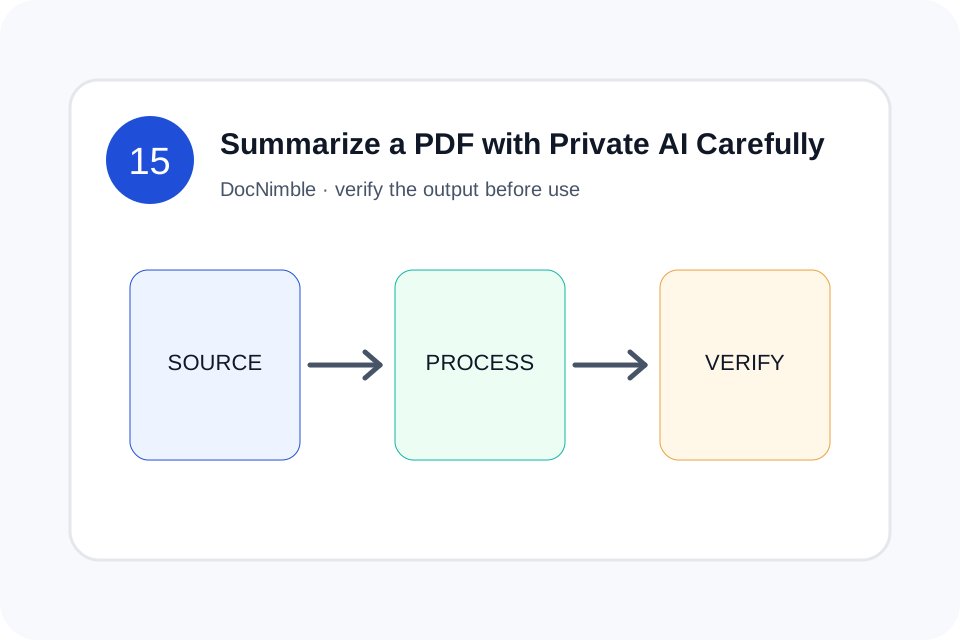
Generate a concise working summary from extractable PDF text using the configured private Ollama model, with explicit limits on grounding and review. This guide focuses on a reliable workflow rather than simply producing a download. A document utility is useful only when the generated file satisfies the receiving system and still preserves the information that matters.
Before you change the file
Keep an untouched source copy and write down the actual destination requirement. A PDF can contain more than visible pages: searchable text, forms, annotations, bookmarks, attachments, metadata, embedded fonts and digital signatures can all behave differently after editing or conversion. Decide which of those features matter before choosing a tool. If the requirement comes from an examination, government service, employer or financial institution, use its current official instructions as the authority. DocNimble's admin-managed portal records are deliberately source-verification gated so an old limit is not presented as current merely because a landing page exists.
Recommended workflow
- Confirm the PDF contains extractable text; use OCR first for scans.
- Do not use an AI summary as a substitute for reading contractual, legal, medical, financial or safety-critical source material.
- The worker extracts a bounded text excerpt and sends it to the locally configured Ollama service rather than a public third-party AI API.
- Save the generated summary as a working note.
- Check every important claim, date, amount, name and obligation against the source PDF.
- Quote or cite the original document directly when accuracy or auditability matters.
Why this workflow is designed this way
Generate a concise working summary from extractable PDF text using the configured private Ollama model, with explicit limits on grounding and review. The safest sequence is reversible first and destructive last. That means preserving the source, making one controlled derivative, measuring or inspecting the result, and only then applying stronger compression or conversion if the receiving requirement still is not met. Repeated transformations make troubleshooting difficult because it becomes unclear which step introduced a missing page, blurry number, broken signature or changed layout.
DocNimble separates public information pages from ad-free workspaces. Client tools execute in the browser and should say so explicitly; worker tools use authenticated server processing and should describe upload and retention honestly. This distinction is particularly important for identity, academic, employment and financial records.
Important limitations and failure modes
- Long documents can exceed the bounded excerpt and therefore may not be fully represented.
- Language models can omit qualifiers or over-compress nuance.
- Poor OCR creates poor source text for summarisation.
- A fluent summary can still be wrong, incomplete or misleading.
No online utility can guarantee that an external portal will accept every file. A receiving system can enforce unpublished validation rules, experience temporary outages or reject content for reasons unrelated to the transformation. Treat a successful DocNimble download as evidence that a result file was created, not as certification by the destination.
Verification checklist before submission or sharing
- Compare headline conclusions with source sections.
- Search the PDF for every critical number.
- Check whether appendices were included in the extracted range.
- Keep the source PDF with the summary.
- Label summaries as generated notes when sharing them internally.
Use an independent viewer for the final check when the document is important. Compare the page count, first and last pages, names, dates, amounts, signatures, QR codes, photographs and other high-value details. If searchable text matters, test search and copy/paste. If a hard size ceiling applies, check the saved byte count rather than relying on a displayed quality setting.
Privacy and retention
AI processing uses the private worker and local model configuration, but the PDF is still deliberately uploaded into protected worker job storage. The tool stays beta until the complete website-to-worker-to-download path is accepted.
Browser processing still happens on a real device. Browser extensions, malware, synced Downloads folders, screenshots and local backups can expose a document even when the website does not upload the source. Close the tab after use and follow the security expectations appropriate to the information in the file.
Common questions
Does a successful download mean the destination will accept it?
No. It means DocNimble created a file. Check the destination's current size, format, encryption, dimensions and content rules.
Should I overwrite my original?
No. Keep the original until the task is accepted and any audit or correction period has passed.
Can I rely on an old portal specification?
No. Use the current official source. DocNimble portal-specific pages should remain non-indexable until an operator records a current source and verification date.
What should I do when the output looks wrong?
Stop and return to the original. Change one setting or one transformation at a time, regenerate, and compare again. Do not stack repeated lossy conversions merely to force a smaller number.
Practical conclusion
Summarize a PDF with Private AI Carefully is most reliable when the output is treated as a controlled derivative with an explicit destination, a preserved source and a written verification step. Use the least destructive operation that meets the real requirement, prefer browser processing for sensitive files when the operation is reliable there, and use worker processing only when specialist software is genuinely needed.